
Backed by the field. Proven in the literature.
Hundreds of peer-reviewed publications support VsSurf analyses — and the engineers who use ReMi® every day have plenty to say about it.
In their words.
I've personally used ReMi since 2005 on hundreds of sites at this point, and is my goto method for shear wave velocity to 100'+ (usually 300'+) even above DHS, CHS, SCPT and refraction surveys. I've used the method on small retail sites to industrial sites to deep TBM tunnels to levees to power/nuclear sites… with and without surface coverings (such as pavements)… many of which were blind surveys. The method provides invaluable data in seismic site class determination and especially SSSA w/ SRA per ASCE7. Many thanks for your whitepapers and expert support thru the decades!
New Albion Geotechnical has worked with Dr. Louie on numerous occasions, with applications ranging from challenging design projects to applied research. The use of refraction microtremor investigations to develop shear wave velocity (Vs) profiles for dynamic site response analysis and nonlinear soil-structure interaction has been the primary focus of our project work. We have always benefited from his insights, thorough review of data, and practical perspectives. Dr. Louie has provided assistance with Vs data from his archives, review of refraction microtremor data and interpretation developed by others, and with the development of project-specific requirements for efficient, reliable surface wave investigations. We consider the project-specific measurement of Vs an integral part of our geotechnical site characterization for seismic applications and look forward to continuing interaction with Dr. Louie and Terēan.
Let me start by saying that the VsSurf software is very user friendly! Secondly, the training and support that comes with VsSurf is unmatched! Alison [Lead Geophysicist & Operations Manager — Terēan] is definitely focused on making sure that the client is familiar and knowledgeable with both the software, and the field equipment used to obtain the data. The expertise of the Terēan Team is simply amazing!
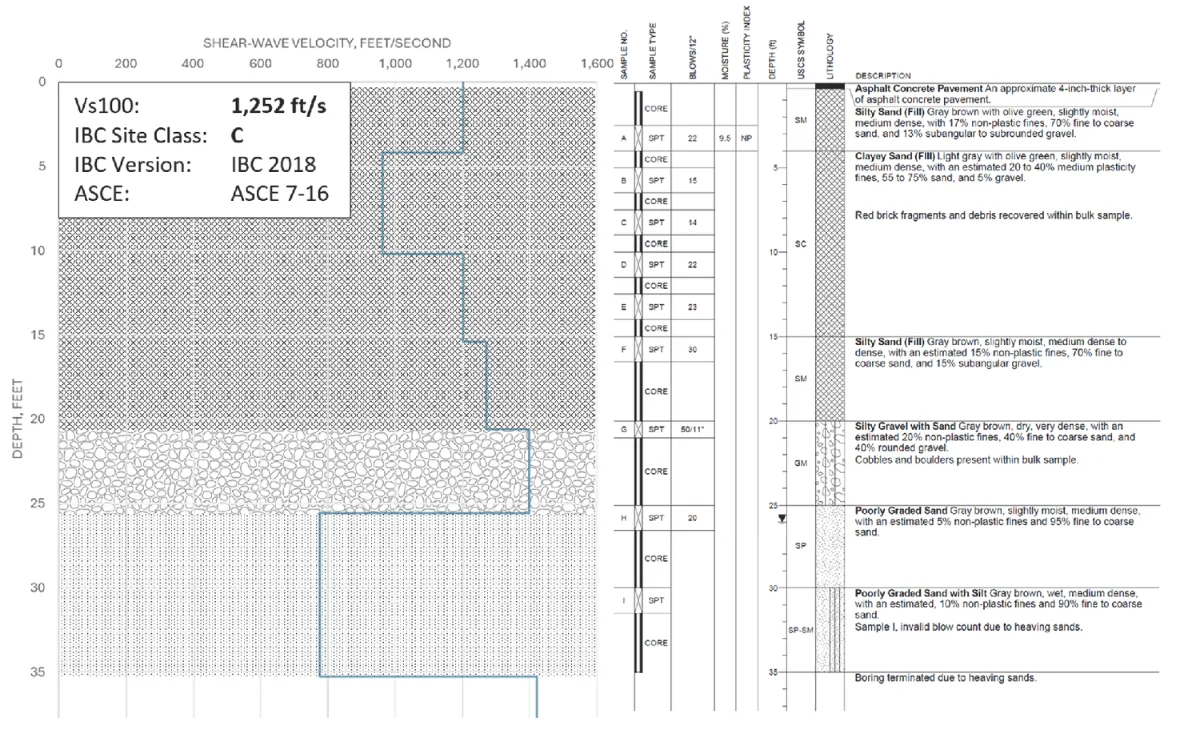
The results from the last job I did turned out great – the Vs100 came within 3 ft/s of seismic CPT down to 100 feet.
We did the ReMi line first and saw that there was a loose, low velocity layer until about 20-30 ft. Additionally, groundwater was estimated to be around 27 ft. The soil turned out to be liquefiable from about 19-26 ft. We definitely would not have done a 50 ft boring if we did not see the ReMi data first.
Two decades of peer review.
Published in 2001 — and refined, compared and extended to basin scale ever since.
-
2022
“A primary benefit of utilising the geophysical measurements is the ability to extrapolate geotechnical knowledge between sparsely distributed and more costly investigation methods (e.g. boreholes, CPT investigations, and test pits) towards increasing spatial sampling density so that background and anomalous conditions can be identified early in the investigation.”
Pancha, A., and R. A. Apperley. Multidisciplinary site investigations: refraction microtremor surveys. Journal of Seismology, 22 Apr. 2022.
-
2021
“The geotechnical industry has widely adopted the refraction microtremor shear-wave velocity measurement technique, which is accepted by building authorities for evaluation of seismic site class around the world.”
Louie, J.N., Pancha, A. & Kissane, B.. Guidelines and pitfalls of refraction microtremor surveys. J Seismol, vol. 26, no. 4, pp. 567–582, 7 June 2021.
-
2017
“Our results confirm the ability of the ReMi technology to image deep velocity structure, including depths exceeding 1 km. We refer to this new methodology as deep ReMi. As demonstrated by this study, deep ReMi can characterize shear-velocity sections down to geophysical basement at 1 km depth, using overlapping subsets of instruments and defining lateral changes that allow derivation of basin structure and geometry.”
Pancha, Aasha, et al.. Determination of 3D Basin Shear-Wave Velocity Structure Using Ambient Noise in an Urban Environment: A Case Study from Reno, Nevada. Bulletin of the Seismological Society of America, vol. 107, no. 6, pp. 3004–3022, 7 Nov. 2017.
-
2017
“Data from the Parcel Map contributes valuable information toward earthquake-hazard assessment by identifying soil properties to >30 m depth. The 1D velocity–depth profiles obtained for the Parcel Mapping presented in this study frequently obtained velocity structure as deep as 100 m and provide information regarding near-surface shear-wave velocity values, soil thicknesses and interface depths, maximum depth limits for soils, depths to bedrock, and soil resonant frequencies.”
Pancha, Aasha, et al.. Large-Scale Earthquake-Hazard Class Mapping by Parcel in Las Vegas Valley, Nevada. Bulletin of the Seismological Society of America, vol. 107, no. 2, pp. 741–749, 28 Feb. 2017.
-
2013
“Since surface wave velocity is related to shear wave velocity and thus material strength, interpreted low surface wave velocity zones have the potential to indicate planes or zones of weakness in a geo-material mass. Such distinctions may be interpretable using appropriate seismic methods even when they are not observable in drilling and sampling operations.”
Rucker, Michael L, et al.. Refraction Microtremor Characterization of a Landslide SR 14, Cedar Canyon, Utah. Geo-Congress 2013, 25 Feb. 2013.
-
2005
“Results of this blind comparison study in Santa Clara Valley, California, support the use of ReMi and MASW in urban areas as viable techniques for obtaining Vs to as deep as 100 m, a depth important for earthquake hazards assessment. At three of the sites, ReMi data [exceeded MASW depths and] could be interpreted to at least 160 m.”
Stephenson, W. J., et al.. Blind Shear-Wave Velocity Comparison of ReMi and MASW Results with Boreholes to 200 M in Santa Clara Valley: Implications for Earthquake Ground-Motion Assessment. Bulletin of the Seismological Society of America, vol. 95, no. 6, pp. 2506–2516, 1 Dec. 2005.
-
2001
“Current techniques of estimating shallow shear velocities for assessment of earthquake site response are too costly for use at most construction sites… the refraction microtremor technique quickly produces good results from a wide range of hard and soft sites… Even home builders might now be able to afford a shear-velocity evaluation at every home site. If engineers and builders find this technique useful, seismologists can look forward to an explosion in the number of available shallow site characterizations.”
Louie, John N.. Faster, Better: Shear-Wave Velocity to 100 Meters Depth from Refraction Microtremor Arrays. Bulletin of the Seismological Society of America, vol. 91, no. 2, pp. 347–364, 1 Apr. 2001.
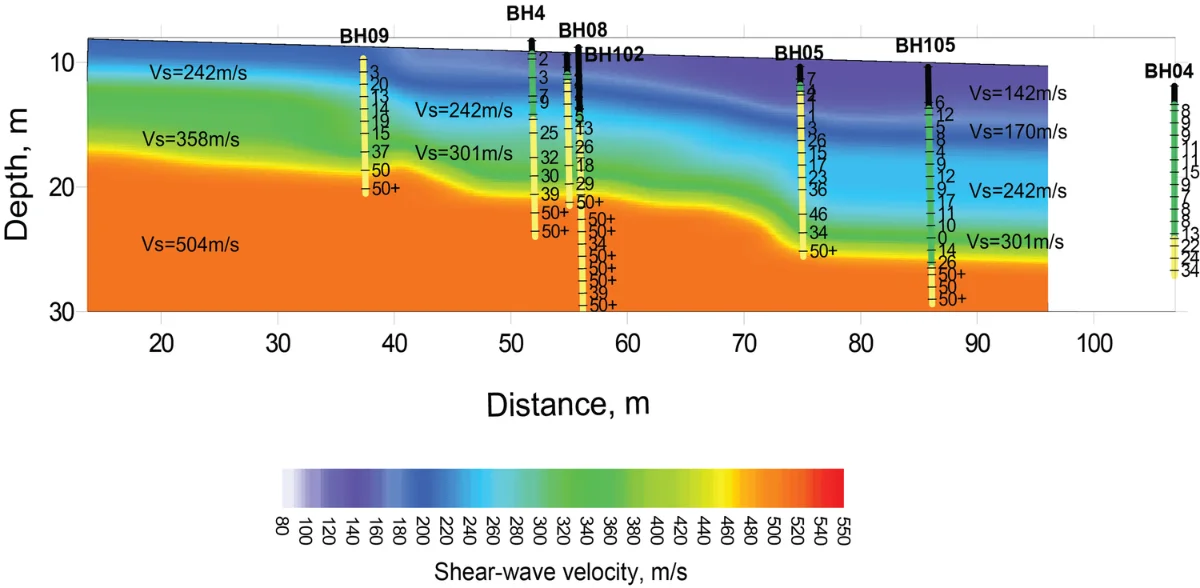
Velocity sections that line up with the boreholes.
Watch ReMi® in action
Videos from the Terēan® team on our YouTube channel.
Ready to see what’s underground?
Talk with a Terēan geophysicist about your site, your data, or the right system for your team.